Links / Ai
-
Luke Wroblewski argues that AI has flipped software development: first we had designers design a feature, and engineers sort out what code they needed to ship it; now, engineers build a feature using AI, and designers sort out the UX and UI needed to polish it.
I'm unsure if this actually is faster. I'm aware that some of the upfront work designers do can slow things down—there is a balance to how much one should do upfront, and how much should be done in code—but I think designing a feature, ideally, is a little more than “cleaning up” after the engineers, as Luke describes.
There's quite a lot of collaborative design work (or design thinking, if you will) to be done to enable a designer and/or engineer to effectively (vibe)code their way to a working prototype or feature.
-
Researchers at MIT's Media Lab published a study titled Your Brain on ChatGPT: Accumulation of Cognitive Debt when Using an AI Assistant for Essay Writing Task, and the results are somewhat concerning. 54 subjects were divided into three essay-writing groups (one using ChatGPT, one using Google, and one using nothing at all).
Researchers used an EEG to record the writers’ brain activity across 32 regions, and found that of the three groups, ChatGPT users had the lowest brain engagement and “consistently underperformed at neural, linguistic, and behavioral levels.”
Over months, ChatGPT users got lazier and lazier.
The paper has not been peer reviewed yet, but its authors wanted to release it ahead of time to draw attention to the long-term effects of outsourcing our thinking. As they said, about those who used ChatGPT to write their essays: “the task was executed, and you could say that it was efficient and convenient. But as we show in the paper, you basically didn’t integrate any of it into your memory networks.”
My own usage of ChatGPT, or AI in general, is primarily for outsourcing otherwise tedious work that stops me from being creative (a recent example: using Warp to dive into documentation for Eleventy or Ghost, to help me set up a basic framework to start building sites). Using AI as a tool for learning or understanding, rather than mindless creation.
-
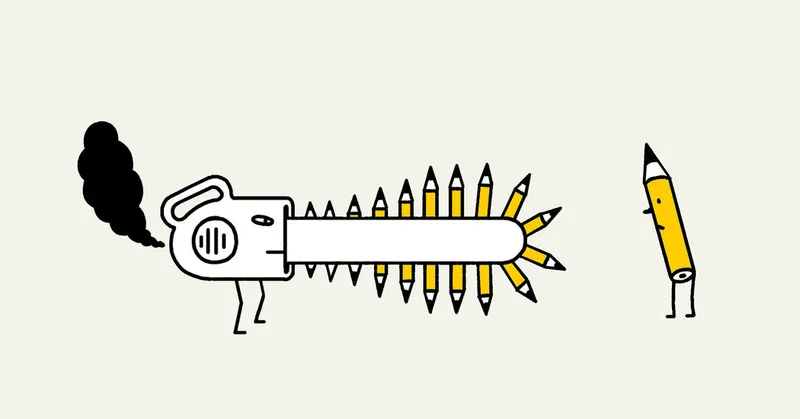
First shared with me by Timo, Christoph Niemann confonts his fears about A.I. art, using smart illustrations and storytelling, in The New York Times Magazine.
My survival as an artist will depend on whether I’ll be able to offer something that A.I. can’t: drawings that are as powerful as a birthday doodle from a child.
-
Taste at speed
№ 55As I was finishing up writing a talk for Adyen's Studio Day (on designing and writing with attention and intention, on quality and craft, on taste, and on AI tooling), an email arrived in my inbox. In it was the latest post by Carly Ayres, writer, and previous co-founder of HAWRAF, and it reinforced the line of thinking I'd been on.
She writes about taste, speed and AI and how, while AI may lower the bar to get to a decent first draft of whatever it is you're creating, speed doesn't always indicate progress. Progress may just be movement.
Tools produce polish, but not perspective.
I see many people writing about this at the moment. About how perspective and taste are what can set a good designer apart. About how creative constraints and thoughtful revision are key to an outcome that's good, and not just finished.
-
“ChatGPT rejects any notion of creative struggle.” Nick Cave's elaborate and thorough answer to questions about ChatGPT and creativity, written on his Red Hand Files blog, read aloud by Stephen Fry.
